Your phone has 94 apps. You have 3,472 unread emails in your inbox. Your desktop resembles a yard sale. Sound familiar?
Most people now spend more of their lives inside their devices than out. But hardly anyone thinks of cleaning up their digital world the same way they do their room or car. The result? Perpetual distraction, wasted time, and that nagging sense that things are out of control.
The catch is, you don’t need a weekend-long digital detox to fix it. You only need a few small, repeatable habits.
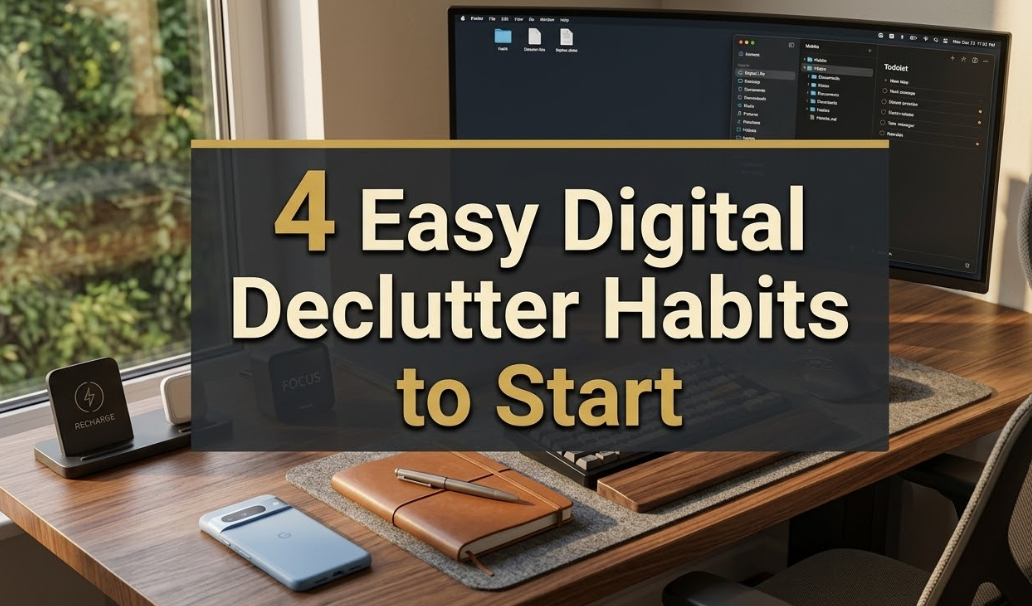
In this guide, you will find the 4 digital declutter habits to start today — habits that are simple enough to understand and quick enough to build into your routine, yet powerful enough to change how you feel every time you pick up your phone or open your laptop.
Let’s get into it.
What Is Digital Decluttering (And Why It Matters)?
Digital decluttering is cleaning up your digital life — getting rid of things that no longer serve you. It applies to old emails, apps you never use, cluttered desktop folders, social media accounts you scroll through mindlessly, and notification overwhelm.
Think of it like cleaning your room. When your room is clean, you feel less anxious and have a sense of control. When it’s messy, everything feels harder.
Your digital world operates in a similar way.
Research by the American Psychological Association has shown that clutter — even digital clutter — contributes to increased stress levels. A study by RescueTime found that the average person spends more than three hours a day on their phone, with large chunks of that time spent on things they didn’t actually plan to do.
Digital clutter is hard to spot. You don’t really notice it stacking up until one day your phone is full, your inbox is a disaster zone, and there’s a low-grade anxiety you just can’t explain.
That’s where these habits come in.
Why Most Digital Cleanups Don’t Last
Before diving into the habits themselves, it’s worth asking: why do people start decluttering their digital lives but most don’t follow through?
The answer is simple. They treat it as a one-time project, not a daily habit.
You might spend four hours clearing out your inbox one Saturday — and by Wednesday it’s full again. You delete 30 apps from your phone — and three weeks later you’ve downloaded 20 more.
The difference between a cluttered digital life and a clean one isn’t about one massive cleanup session. It’s small habits done consistently.
All four of the habits below are designed to be performed quickly, repeatably, and with minimum effort. Done regularly, they prevent digital clutter from accumulating in the first place.
Habit 1: The Daily Inbox Reset

Your Email Inbox Is Not a Storage Unit
Most people treat their email inbox like a filing cabinet. Emails pile up for months or even years. Important messages get buried. And every time you open your email, your brain has to sort through hundreds of unread items just to find the one thing you actually need.
The daily inbox reset solves this.
The concept is straightforward: each day, you work toward something called “inbox zero.” That doesn’t mean responding to every email. It means getting your inbox clear of everything that doesn’t belong there.
Here’s how to do it:
Step 1 — Delete immediately. If an email is junk, spam, or something you’ll never need, delete it as soon as you read it. Don’t let it sit there.
Step 2 — Unsubscribe aggressively. Unsubscribe from newsletters, promotional emails, or notifications you never signed up for. Tools like Unroll.me or your email provider’s built-in unsubscribe feature make quick work of this.
Step 3 — File it or reply. If an email requires a response, reply now or flag it for later. If it’s something you need to keep, move it into a labeled folder. If it doesn’t fit either option, delete it.
Step 4 — Set a time limit. Give yourself a maximum of 10–15 minutes per day. Set a timer. Perfection has no place here — just momentum.
The 2-Minute Rule for Emails
If an email takes less than two minutes to handle, deal with it immediately. Don’t let it sit.
This rule — from productivity expert David Allen’s Getting Things Done method — is one of the most effective ways to stop small tasks from turning into big mental burdens.
How Often Should You Check Email?
Here’s something that might surprise you: most productivity experts recommend checking email only two to three times a day at set times, rather than keeping your inbox open constantly.
Constantly checking email conditions you for chronic distraction. You’re never truly focused on what you’re doing because you’re always waiting for the next message.
Choose your email check-in windows — say, 9 AM, 1 PM, and 5 PM — and stick to them. Close the app outside those windows.
The daily inbox reset, done consistently, takes 15 minutes max a day. But it frees up a significant amount of mental bandwidth.
Habit 2: The Monthly App Audit

Your Phone Is Packed With Apps You Haven’t Used in Months
The average smartphone user has between 80 and 100 apps installed. Fewer than 10 of them are used regularly by most people.
That’s a lot of digital weight to carry around.
Apps consume storage, drain your battery, send you notifications, and — most importantly — take up mental space. Every time you scroll past an app you don’t use, some small part of your brain registers it as unfinished business.
The monthly app audit is about shedding that weight.
How to Run an App Audit
Set a reminder for the first of every month. When it goes off, do this:
Step 1 — Scroll through every screen. Look at every single app. Ask yourself: Have I used this in the past 30 days? If the answer is no, it goes on the list.
Step 2 — Delete without guilt. If you haven’t used it in a month, delete it. If you ever really need it again, you can redownload it in 30 seconds. Nothing is lost.
Step 3 — Organize what’s left. Group your remaining apps into folders. Keep your most-used apps on your home screen. Everything else goes into folders or secondary screens.
Step 4 — Turn off notifications. While you’re in your app settings, check which apps have permission to send you notifications. Most don’t need it. Turn them off for anything that isn’t urgent or important.
Here’s a simple guide to help you decide which apps to keep and which to delete:
| Ask This Question | If Yes → | If No → |
|---|---|---|
| Did I use this in the last 30 days? | Keep it | Delete it |
| Does it serve a clear purpose? | Keep it | Delete it |
| Does it add stress or distraction? | Consider deleting | Keep it |
| Can I access this through a browser? | Delete the app | Keep it |
| Does it send me notifications I ignore? | Turn off notifications | Leave it |
What About Apps That “Could Be Useful Someday”?
This is the trap most people fall into — the “just in case” apps.
A good rule: if you can’t name a specific, upcoming situation in which you’ll use an app, delete it. The “just in case” mindset is exactly what fills up a garage with things nobody ever touches.
Habit 3: The Weekly Desktop and Downloads Reset
A Cluttered Desktop Is Slowing You Down More Than You Know
This one is easy to overlook because your desktop and downloads folder feel almost invisible. You don’t look at them the same way you look at your phone screen.
But here’s the thing. Every file on your desktop represents an unfinished decision. Your brain — even subconsciously — registers all of it as noise.
Research in cognitive science has found that visual clutter competes for your attention, even when it’s not at the center of your focus. A messy desktop creates quiet mental background noise that saps your concentration.
The weekly desktop reset takes care of this.
Just like designing a minimal, distraction-free workspace can improve how you think and work physically, a clean digital desktop does the same thing for your screen life.
The Friday or Sunday Clear-Out
Choose one day of the week — Friday afternoon before you sign off, or Sunday evening before the new week begins. Then spend 10 minutes doing this:
Step 1 — Tackle the desktop. Every file on your desktop either gets filed into a proper folder, moved to the trash, or placed somewhere intentional. Your desktop should be empty (or close to it) by the time you’re done.
Step 2 — Clear the downloads folder. Your downloads folder is a digital junk drawer. Open it, sort by date, and delete anything you no longer need. Move anything important to the right folder.
Step 3 — Empty the trash. It sounds obvious, but most people forget. Empty it. The files are still taking up space until you do.
Step 4 — Organize your folders. Spend two to three minutes making sure your core folders (Documents, Work, Personal, Photos, etc.) are in order. If something doesn’t fit anywhere, create a new folder or delete it.
A Folder Structure So Simple It Might Actually Work
You don’t need a complicated filing system. Simplicity is what makes it stick. Here’s an example:
| Folder | What Goes In It |
|---|---|
| Work/Projects | Active work documents, organized by project |
| Archive | Finished projects, old tax docs, things you need to keep but rarely touch |
| Personal | Recipes, budgets, personal writing |
| Photos | Organized by year and month |
| Inbox (temp) | Anything you haven’t sorted yet — cleared out weekly |
The “Inbox” folder is key. Instead of leaving files scattered on the desktop, you drop them into Inbox temporarily. Then, during your weekly reset, you deal with them.
Habit 4: The Social Media Unfollow Sweep
You Are Following People Who No Longer Add Anything to Your Life
Think about your social media feeds right now. How much of what you see actually makes you feel good, informed, or inspired?
For most people, a large portion of their feed is filled with accounts they followed years ago and no longer care about. Old classmates, brands they once liked, news accounts that leave them anxious, influencers they followed for a week before losing interest.
Every piece of content in your feed is competing for your attention. The more accounts you follow, the noisier your feed gets — and the harder it is to find the content that actually matters to you.
The social media unfollow sweep is about curating your feed so it works for you, not against you.
How to Do an Unfollow Sweep
This one works best done monthly or quarterly, depending on how active you are on social media.
Step 1 — Review who you follow. On most platforms, you can see a full list of accounts you follow. Go through it slowly.
Step 2 — One question per account. Does this account add value — information, joy, inspiration, connection — to my life right now? Not “did it once” or “might it someday.” Right now.
Step 3 — Unfollow without overthinking. If the answer is no, or even a weak maybe, unfollow. On most platforms, people aren’t notified when you unfollow them. There’s no drama. Just a cleaner feed.
Step 4 — Mute instead of unfollow when needed. Sometimes you can’t unfollow a work contact or family member but still don’t want to see their content. Use the mute function. It’s quiet, and it works.
The Emotional Side of Unfollowing
Some people feel guilty about unfollowing, especially friends or family. But here’s a reframe that might help:
Following someone on social media is not the same as caring about them. You can love someone deeply and still choose not to follow them if their posts create stress or negativity in your feed.
Your attention is one of your most valuable resources. Protecting it isn’t rude — it’s responsible.
Setting Time Limits on Social Media Apps
After you clean up your feed, go one step further. Use your phone’s built-in screen time tools (Screen Time on iPhone, Digital Wellbeing on Android) to set daily limits on social media apps.
According to research by DataReportal, the average person spends nearly 2.5 hours per day on social media. Even cutting just 15 minutes per day adds up to more than 90 hours a year — nearly four full days of your life back.
What These Habits Actually Look Like in Your Routine
Knowing four habits is one thing. Actually doing them is another.
Here’s a simple weekly schedule that makes it easy:
| Day | Habit | Time Required |
|---|---|---|
| Monday–Friday | Inbox reset (daily) | 10–15 min |
| Friday or Sunday | Desktop and downloads reset | 10 min |
| First of the month | App audit | 15–20 min |
| Once per quarter | Social media unfollow sweep | 20–30 min |
Total monthly time investment: roughly 2–3 hours.
That’s it.
Most people spend more time than that in a single mindless scroll session. These habits are genuinely low-effort compared to how much they give back.
The Bigger Picture: Why a Clean Digital Life Matters
Digital clutter isn’t just annoying. It has real consequences for your mental health and productivity.
A cleaner digital environment helps you:
Focus better. Fewer notifications, fewer distractions, less decision fatigue.
Feel less stressed. Clutter — whether physical or digital — can trigger low-level anxiety. Clearing it reduces that background noise.
Save time. When your files are organized and your apps are intentional, you spend less time searching for things and more time actually doing them.
Sleep better. Many people scroll through social media or check email right before bed. A cleaner, more deliberate relationship with your devices makes it easier to put them down at night.
Feel more in control. This may be the most underrated benefit. There’s a quiet confidence that comes from having your digital life in order. It’s one less thing your brain has to worry about.
FAQs About Digital Decluttering
Q: When can I expect to see results from digital decluttering? Most people notice a difference within the first week. Your inbox feels more manageable, your phone feels lighter, and your screen time often drops naturally — not because you’re forcing it, but because less is pulling at your attention.
Q: What if I’m afraid to delete something important? For files, create an “Archive” folder and move things there instead of deleting them. For apps, remember that nearly anything can be redownloaded if you need it. Start with the obvious — apps you clearly haven’t opened in months, emails that are obviously junk — and build your confidence from there.
Q: Is digital decluttering the same as a digital detox? No. A digital detox typically means stepping away from technology entirely, often for a day or a weekend. Digital decluttering is about making your everyday digital life better, not withdrawing from it. The two can work in tandem, but they’re different things.
Q: What about photos? There are thousands of them. Photos deserve their own dedicated cleanup session and are worth tackling separately. As a starting point: back everything up to the cloud, then go through and delete obvious duplicates and blurry shots. Apps like Google Photos can help identify duplicates automatically.
Q: How do I stop digital clutter from building back up? The habits in this article are your answer. The key insight is that digital clutter isn’t a problem you solve once — it’s something you manage over time with small, consistent actions. The four habits above are designed specifically to prevent buildup, not just fix it.
Q: Can digital decluttering really improve mental health? It can contribute positively. It’s not a substitute for professional mental health support, but research does show that organized environments — digital ones included — reduce stress and improve focus. Many people report feeling calmer and more in control after cleaning up their digital spaces.
Q: Where should I start if I’m completely overwhelmed? Start with the app audit. It’s the most concrete, visual, and immediately satisfying of the four habits. Deleting 20 apps from your phone takes about 10 minutes and produces a visible, tangible result. That momentum will carry you into the other habits.
Wrapping It Up
Digital clutter is a modern problem, but it doesn’t need a complex fix.
The 4 digital declutter habits to start — the daily inbox reset, the monthly app audit, the weekly desktop reset, and the social media unfollow sweep — are simple enough to repeat consistently and powerful enough to change how you feel about your digital life.
You don’t have to do all of them at once. Pick one. Practice it for two weeks until it feels natural. Then add another.
Small, consistent actions always beat big one-time cleanups. A cleaner digital life is built one tiny habit at a time — and it’s closer than you think.