For most people, productivity is all about working harder or longer.
That’s not true.
The biggest desk productivity victories come from working smarter — arranging your space, habits, and tools in such a way that the work flows naturally. Small changes add up fast. And the best part? You can begin making them today.
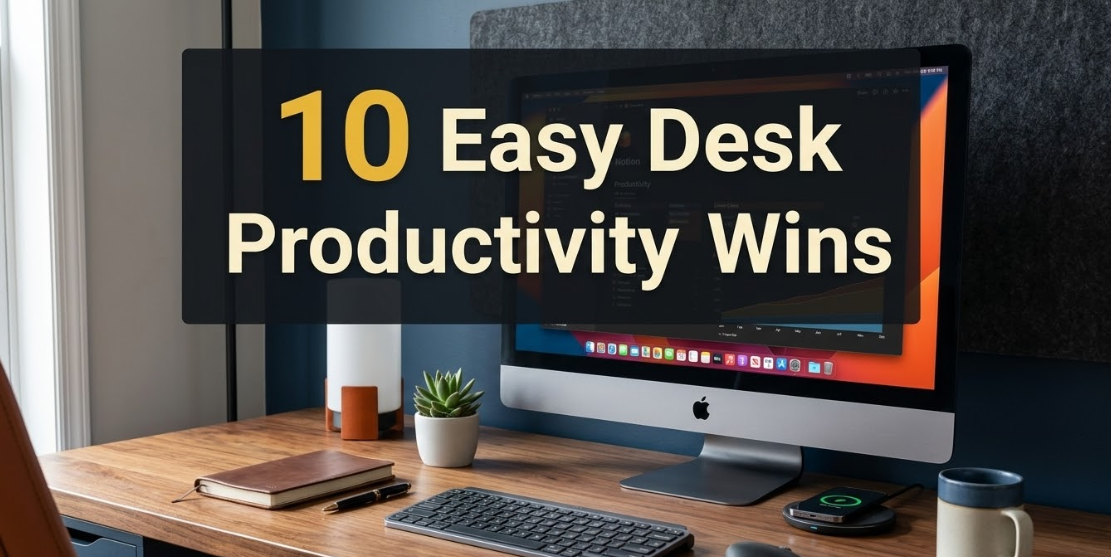
This guide outlines 10 specific, proven productivity victories you can apply to your desk setup today. No expensive gear required. No complex systems to learn. Just actions that are practical and actually move the needle.
Let’s get into it.
Why Your Desktop Arrangement Is Keeping You Back
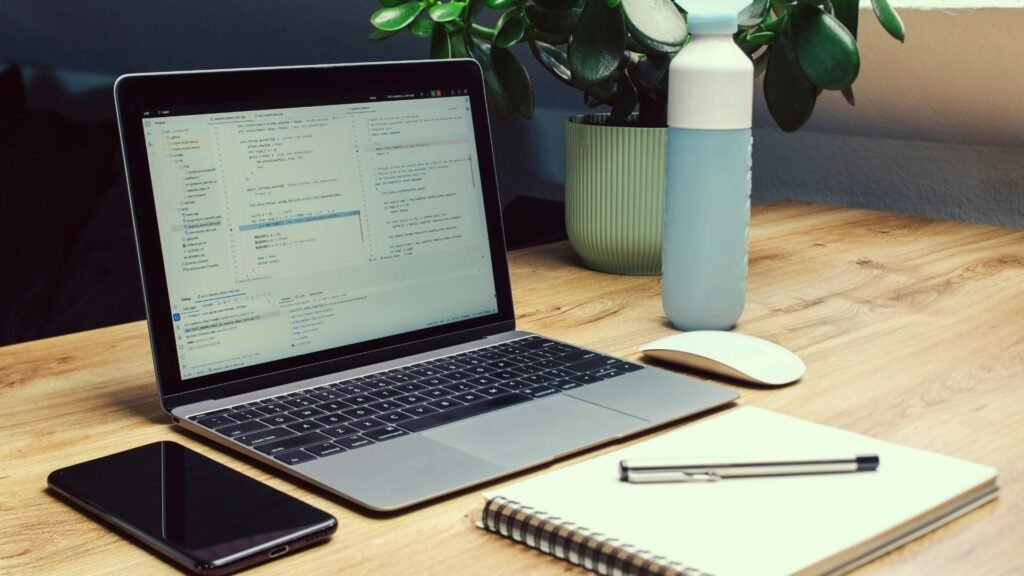
Before we get into the wins, it’s worthwhile to know the problem.
Most desks are not created for concentration. They are meant for storage — a spot to dump stuff, park your laptop, and trust that it will all work out. That sort of setup actually works against your brain’s ability to focus.
Every object in your view that shouldn’t be there is robbing you of a little bit of attention. A stack of papers. A charger you didn’t use this week. A three-day-old coffee mug. Your brain processes all of it, even when you think you are tuning it out.
The result? You sit down to work, but you never truly feel in it. Your attention is everywhere before you even start.
The answer is a sequence of incremental, intentional desk productivity victories that remove friction and let you get started faster — and stay in the zone longer.
10 Desk Productivity Wins You Need Right Now
Win #1 — Declutter Down to Essentials at Your Desk
This is the single fastest desk productivity win you can give to anyone.
Take everything off your desk right now. Every item. Then return only what you really need for work that day. That’s it.
What stays: your computer, a notebook, a pen, your drink.
What goes: everything else. Into a drawer, a shelf, or a box.
A clear surface tells your brain there’s nothing to manage other than the work in front of you. It sounds too easy to make a difference, but people routinely report that their sense of focus improves within minutes of doing it.
You don’t require minimalism. You just need a cleaner desk.
Win #2 — Establish a “Start Work” Trigger
Here is one thing few people know: your brain reacts to rituals.
By repeating the same set of actions before you start working, your brain learns to associate that sequence with focus. Gradually, the ritual becomes the catalyst. Just beginning it should snap your brain into work mode.
Your start work trigger can be anything consistent:
- Grab a coffee, take a seat, and open your notebook
- Put in your headphones, pull up your task list, close the other browser tabs
- Wipe down your desk, place your water bottle to the left of your keyboard, and open your first task
Whatever the ritual, it doesn’t matter. What matters is that it’s always the same. Do it every single weekday for two weeks and notice what happens to your focus.
Win #3 — Block Time, Not Just Tasks
The average to-do list is a wish list.
It provides a list of what has to happen but never answers the one real question: when will you actually do it? Without a time for each task, everything sits in a rough pile — and your brain continues cycling through the list rather than actually working.
Time blocking is the fix.
Open your calendar. Plan every major task into its own unique time slot. When it is that time slot, you do that task and nothing else. When it’s time for the slot to end, you move on.
This is one of the highest-impact desk productivity wins you could ever add. It transforms your task list from a static stack into an active agenda. Your brain knows what’s coming next, so it stops juggling mentally and starts executing.
How to start: Tomorrow morning, block your top three priorities. Allow 45–90 minutes for each. Then treat those blocks as meetings you couldn’t cancel.
Win #4 — Get Over Your Cable Problem Once and For All

This one sounds like housekeeping. It’s actually a focus strategy.
A visible cable mess creates background noise for your eyes. Every time your eyes land on a tangle of wires, your brain processes it as clutter — even if only for a split second. Those fractions add up over the course of a workday.
Do this once in 20 minutes:
- Use velcro ties to bundle cables together
- Guide them behind or underneath your desk
- Use a cable box for hiding power strips
- Label cords if you have to disconnect them often
This desk productivity win, done once, lasts for months. Your desktop instantly appears cleaner, and the cognitive noise shrinks along with it.
Win #5 — The Single-Task Rule
Here is a hard truth: multitasking doesn’t work.
Neuroscience has long demonstrated that what we think of as multitasking is, in fact, task-switching — and each switch exacts a toll in time and mental energy. A large-scale study from the American Psychological Association noted that when switching from one type of task to another, up to 40% of productive time can be lost.
The single-task rule means working on precisely one thing until it gets done — or the scheduled time block ends.
Close the extra tabs. Silence the chat apps. Put your phone face-down. Set a timer if it helps.
It feels slow at first. But you’ll get things done faster and with fewer errors when your mind isn’t hopping among five things at once.
This is one of those desk productivity wins that costs nothing to set up. It just needs a decision.
Win #6 — Create an End-of-Day Shutdown Ritual
Most people stop working and never truly complete the workday.
They close the laptop mid-task. Leave half-written emails. Walk away from a to-do list still running in their head. That mental chatter then follows them into the evening and they begin the next day already fatigued.
An end-of-day shutdown routine solves this problem.
The concept is simple: take five to ten minutes at the end of each workday to perform the same series of closing tasks.
- Review what you completed
- Plan out your three most important tasks for tomorrow
- Close all browser tabs
- Clear your desk surface
- Say something like “shutdown complete” — a phrase that signals finality
That last step sounds silly. But it works. Research by Professor Cal Newport, who popularized this approach, reveals that a clear verbal or physical marker aids the brain in letting go of work thoughts. You no longer carry the day around with you.
A proper shutdown is one of the most underrated desk productivity wins. It doesn’t just help today — it prepares tomorrow.
Win #7 — Go Analog With Your Daily Task List
Digital task apps are powerful. They are also rife with rabbit holes.
Opening a task app usually involves an avalanche of notifications, sync problems, project updates, and dozens of other micro-decisions before you even get to your real list. That’s mental overhead before you’ve done a single thing.
Consider switching to a paper task list for daily planning.
List three to five things you are going to do today, every morning. That’s your list. Nothing else goes on it.
Paper is slower to add to, which requires you to be selective. And there’s real satisfaction in physically crossing something off — a small reward signal that sustains momentum for the rest of the day.
This is not about giving up your digital tools. It’s about decoupling planning from doing. Plan on paper. Execute with your digital tools.
Win #8 — Master the Keyboard Shortcuts You Use Most
This one sounds boring. It pays dividends every day until you stop working.
The average knowledge worker repeats the same 10–15 actions day in, day out: copy, paste, switch apps, find text, open new tab, screenshot, format text. If each of those takes 3–5 seconds with a mouse rather than a keyboard shortcut, that adds up to hours lost per week.
Start with the keyboard shortcuts for your three most used tools. Learn them over one week. Use only them until they are automatic.
Highest-value shortcuts to master first:
- Open application switcher (Alt+Tab / Cmd+Tab)
- Spotlight / Quick launch (Cmd+Space or Windows key)
- Close a tab (Ctrl+W / Cmd+W)
- Reopen last closed tab (Ctrl+Shift+T / Cmd+Shift+T)
- Lock your screen (Windows+L / Ctrl+Cmd+Q)
Every shortcut you learn is a small, permanent desk productivity win that adds up over years.
Win #9 — Adjust Your Desk Height and Screen Position
This is the desk productivity win that no one talks about — but nearly everyone needs.
If your chair, desk, and screen are misaligned, your body spends all day battling discomfort. A stiff neck, aching wrists, or a sore lower back gnaw away at your concentration, even when you’re not consciously aware of them.
The fundamental rules of ergonomic setup are straightforward:
Chair: Your feet should be flat on the floor. Your thighs should be approximately parallel to the ground. You should have support for your lower back.
Desk height: When your hands are on the keyboard, your elbows should be at approximately 90 degrees. If your desk is fixed and too high, a keyboard tray helps. If it’s too low, monitor risers or a standing desk converter can bridge the gap.
Screen: The top of your monitor needs to be at or below eye level. The screen should be at arm’s length — approximately 50–70 cm from your face. If your laptop is on your desk, consider using it with a stand plus a separate keyboard.
Take 10 minutes to adjust your setup today. The increase in comfort — and therefore focus — can be striking. For more ideas on creating an ergonomic and distraction-free workspace, visit Minimal Workspaces.
Win #10 — Batch Your Notifications Into Two Windows
The ultimate enemy of productivity that’s hiding in plain sight is notifications.
Each ping, pop-up, or banner is a context switch. Even if you don’t respond fully, your brain registers the interruption. Studies from the University of California Irvine have reported that it takes an average of 23 minutes to fully regain focus after a distraction.
The batching solution is simple: select two windows each day where you check and respond to messages. For example, 10 AM and 3 PM. Outside of those windows, notifications are off.
For blocks of deep work, this means phone face-down, Slack snoozed, email tab closed.
This is uncomfortable at first — particularly if others expect rapid responses. But it is worth communicating the shift to your team. Most people adjust quickly, and the quality of work you produce in those uninterrupted stretches far outweighs any minor delays in replies.
This is possibly the easiest desk productivity win to set up and one of the hardest to maintain. But those who stick with it rate it as the most powerful change they ever made to their work life.
How These 10 Wins Fit Together
Each of these wins is powerful in its own right. But the magic comes when you stack them.
Clearing your desk removes visual distraction. Your start work trigger gets your focus started. Time blocking tells your brain what to work on. The single-task rule keeps it there. Notifications are batched to ensure nothing breaks through. And your end-of-day shutdown provides the closure.
When done together, these desk productivity wins create an environment, a routine, and habits that all point in the same direction — towards efficient, high-quality work with less effort and stress.
You don’t need to apply all ten today. Begin with two or three that address your greatest current frustration. Then, once the first ones become second nature, add more.
The Weekly Desk Productivity Checklist
Use this table to keep track of which wins you’ve implemented:
| Win | Done? | Notes |
|---|---|---|
| Clear desk to essentials | — | Takes 10 min |
| Create start work trigger | — | Pick 3 steps |
| Set up time blocking | — | Use your calendar |
| Sort cables once | — | 20 min, done forever |
| Practice single-tasking | — | Start with 1 task block |
| Build shutdown routine | — | 5–10 min daily |
| Switch to paper task list | — | Only 3–5 tasks |
| Learn keyboard shortcuts | — | Pick your top tools |
| Fix chair, desk and screen | — | Use ergonomic guide |
| Batch notifications to 2x/day | — | Communicate with team |
Small Habits That Multiply Your Desk Productivity Over Time
Those ten wins are the key building blocks. These smaller daily habits build on top of them.
Drink water consistently. Dehydration reduces concentration. Keep a water bottle on your desk and refill it every hour. This is one of the easiest desk productivity wins in the physical domain.
Work in focused blocks. The Pomodoro Technique — 25 minutes of concentrated work, 5 minutes of rest — is effective because it compels regular breaks. Your brain requires recovery time in order to stay focused. Don’t push through for hours without a pause.
Keep a “brain dump” notepad nearby. Random thoughts, ideas, and to-dos will come up while you’re in the zone. Instead of acting on those thoughts immediately, write them down and revisit them later. This protects your focus without losing the idea.
Place your phone out of arm’s reach. Research from the University of Texas showed that merely having your phone on the desk diminishes cognitive capacity — even when it’s face down and on silent. Put it in a drawer or in another room during focus sessions.
Review your setup monthly. What worked last month may not work now. Schedules change. Projects change. Spend 15 minutes once a month looking at your desk setup and routines with fresh eyes. Adjust what isn’t working.
FAQs About Desk Productivity Wins
Q: When will I see results from these changes?
Some wins, like cleaning up your desk or adjusting the height of your screen, pay off the same day. Others, such as the start work trigger and notification batching, accumulate over one to three weeks. The more consistently you use them, the quicker you’ll feel the difference.
Q: Do I have to invest in expensive equipment to improve my desk productivity?
No. Most of the wins here cost nothing at all. The highest-impact changes — single-tasking, time blocking, clearing your desk, building routines — require zero purchases. Ergonomic improvements may require a small investment if your setup is very wrong, but even then inexpensive solutions like a laptop stand and a basic external keyboard can make a huge difference.
Q: What if my job involves juggling lots of tasks?
The single-task rule doesn’t mean ignoring other tasks — it means that each task gets its own focused attention slot. Time blocking is crucial if you handle several projects. Use a separate block for each project or task type. Within each block, work on one thing. Between blocks, switch freely. This is how high-level professionals deal with complexity without burning out.
Q: I work in an open-plan office. Can these wins still help me?
Yes. Environmental wins like clearing your desk, setting your screen height correctly, and using noise-canceling headphones are even more valuable in a shared workspace. You can’t control all the noise around you, but you can control your immediate desk zone. For notification batching, share your availability windows with your team — most colleagues respect focused work time when clearly signaled.
Q: Should you apply all 10 wins at the same time or one after another?
One at a time is almost always preferable. Trying to do all things at once creates overwhelm and makes it hard to identify what’s actually working. Choose two wins that will alleviate your biggest pain point this week. When they feel second nature — generally after 10–14 days — add another. Slow adoption means lasting habits.
Q: How does an end-of-day shutdown help with morning desk productivity?
When you finish properly, you’re not starting over the next morning. Your three most important tasks for the day are already on paper. Your desk is already clear. Your brain isn’t trying to pick up yesterday’s lost threads. You sit down, look at your list, and get to work. The morning routine is quicker, calmer, and more productive because last night’s shutdown set it up for success.
Wrapping Up
Desk productivity wins aren’t earned through big, dramatic overhauls.
They are about removing friction. Replacing spontaneous habits with intentional ones. Making it as easy as possible to get to work — and stay at work.
Each of the ten wins in this guide is achievable right now. They don’t need perfect conditions, a dedicated home office, or a large budget.
Start with the desk clear. Build the shutdown routine. Block your time. Batch your notifications.