Much productivity advice looks good on a Monday morning. And it’s all gone by Wednesday.
That is the real problem. It is not that people don’t know what to do. It is that the habits never last long enough to really make a difference.
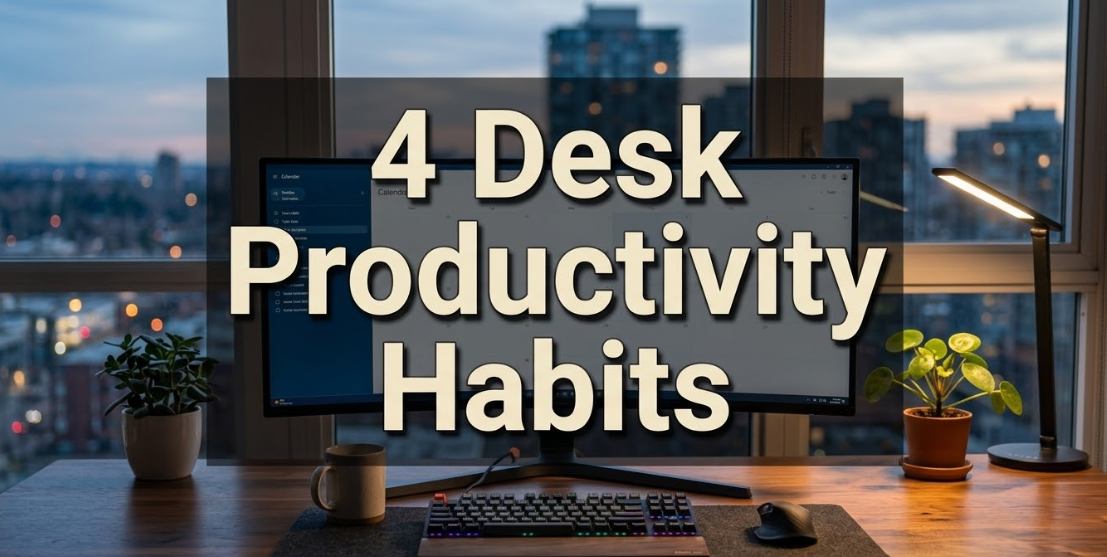
Desk productivity habits are not the same as major life changes. They are little, repeated actions connected to your physical workspace. And because they are tied to something you look at every single day — your desk — they’re far easier to sustain than habits that exist only in your mind.
This post will show you four desk productivity habits that are simple enough to begin today, practical enough to do again tomorrow, and powerful enough to meaningfully shift how much work you’re able to finish over time. No complicated systems. No expensive tools. Just four habits that work.
For more ideas on building a workspace that supports these habits every day, explore Minimal Workspaces — a dedicated resource for clean, focused desk setups.
The Problem with Most Productivity Habits (And What’s Different Here)
Before diving into the four habits, it’s helpful to understand why so many productivity tips don’t work in the first place.
Most tips have you overhaul your mindset, your schedule or your leisure time. That is a big ask. It takes willpower day in, day out, and willpower runs out quickly.
Desk productivity habits work differently. They attach to your environment. The habit is already there waiting for you when you sit down at your desk. You do not have to relearn it all each morning.
Research on habit formation consistently indicates that location-based cues — such as a particular chair or desk — are one of the most potent triggers for repeated behavior. Your desk is more than just a place to work. It is also where habits live.
The three elements required for a habit to stick
Three things need to work in conjunction for a habit to really stick. A clear trigger that sets it off, an action easy enough to do through little more than routine, and a small reward that gives your brain incentive to do it again.
That is why each of the four habits in this article is constructed with those three things in mind. They are linked to your desk, low enough effort (under two minutes) and high enough reward that you will feel the difference soon.
Days to form a habit
18–66
Drop in focus with clutter
~40%
Tasks done with daily planning
2.5×
Habit 1
Two-Minute Desk Reset — Start Clean, End Clean

The very first of the desk productivity habits is also the most crucial one. It sounds almost too simple. At the beginning and end of your workday, give two minutes to restoring your desk to its clean, default state.
That is it. Two minutes. Twice a day.
Starting with a clean desk changes everything
Your brain sees everything in your field of view, even if you think you’re blocking it out. A stack of papers, an old cup of coffee, a tangled charging cable — they are each a small mental tax. You are wasting cognitive energy on clutter when it should be spent on your work.
When you sit down to a clear desk, your brain gets one powerful signal: it’s time to focus. There is nothing vying for attention. This is sometimes referred to as a clean slate effect, and workplace environment studies have consistently supported it.
The end-of-day reset matters just as much. When you leave work with a clear desk, you mentally close the day out. You are not lugging the visual stress of unfinished business into your evening.
How to do the two-minute desk reset
- Clear the surface.Pitch anything that does not belong — dirty dishes, scraps of paper, packaging, items from other rooms. Put them where they actually live.
- Tuck away any cables.Loose charging cords and cables are visual noise. Clip them to the edge of your desk, or coil them beside your device.
- Set up tomorrow’s essentials.Return your notebook, pen and water bottle to their places. Your next session has already begun before you get to it.
- Wipe the surface.Wipe it down with a dry cloth — it takes 15 seconds and makes a more visible difference than you would think.
Pro tip: Combine this habit with something you already do every day — like brewing your morning coffee or powering down your computer for the night. One of the easiest ways to make a habit automatic is to attach it to an existing behavior.
Your desk default state: what belongs where
| Item | On the desk? | Where when not in use |
|---|---|---|
| Laptop or monitor | Yes — always | — |
| Keyboard and mouse | Yes — centered | — |
| Notebook and pen | Yes — top right corner | — |
| Water bottle | Yes — bottom left | Kitchen after work |
| Phone | No — face down or away | Drawer or another surface |
| Papers and documents | No | Folder, drawer, or recycling |
| Dishes and food | No | Kitchen, always |
Habit 2
Write One Thing Down Before Touching Anything Else
The second desk productivity habit takes less than a minute and a half. Before you read your email, before you tap on your phone, before you do anything — take a pen and write down the single most important thing that absolutely needs to get done today.
Just one thing. Not a full to-do list. Not a schedule. One sentence.
What is the issue with going reactive right away?
Most people sit down at their desk and immediately shift to reactive mode. They log in to email and begin replying. They check messages. They deal with whatever seems urgent at the time.
By the time they finally come up for air, half the day is gone, and the one thing that most mattered hasn’t even been looked at.
When you write down your one most important task before anything else, it creates a ten-second pause of deliberate thought. It establishes a tone for the entire day. And having that intention written down on paper — physically there in front of you at your desk — is a quiet anchor that keeps pulling you back to what matters when distractions pile up.
How to pick the right one thing
Each morning, ask yourself: “What is the one thing I can do today that, if I did nothing else, will make this day count?”
It should be specific. Not “work on the project” but “write the first draft of the introduction.” Not “deal with emails” but “respond to the three most urgent client emails.”
Specific tasks have a finish line. Vague ones do not. When you can literally see the end of a task, your brain is much more willing to begin it.
Specific and action-orientedCompletable in a dayTruly importantWritten — not just thought
Why the physical notebook is more important than you realise
There is a reason this habit involves using an actual, physical notebook and not some phone app or digital task manager. Writing by hand stimulates a part of your brain that is different from typing. Research regularly demonstrates that handwriting enhances memory, as well as commitment to a goal.
But beyond the neuroscience, a notebook on your desk sits out in plain view. A phone app does not. When your single task is written in open view right next to the keyboard, it is virtually impossible to forget that it exists.
Keep the notebook small. A5 or similar. It should have a permanent place in the top right corner of your desk as part of your default state.
Habit 3
The Phone-Away Rule — Remove the Biggest Focus Thief
Here is an uncomfortable truth about productivity at a desk: the biggest potential distraction at your desk is probably your phone. Not the internet in general, not loud colleagues, not email — your phone, sitting right at the edge of where you can comfortably reach.
The third desk productivity habit is easy but demands a little determination. When you are ready to work, put your phone where you cannot see or easily reach it.
Studies on phone proximity and focus
A well-cited study from the University of Texas at Austin discovered something remarkable. Even when a phone was placed face-down on a desk — silent and with no notifications — it still reduced participants’ cognitive capacity, compared to the absence of a phone altogether.
Even trying not to check your phone takes mental energy. You don’t even have to look at it. Its mere presence is a drain.
So just turning your phone face-down is not sufficient. You must put it out of physical reach during focused work periods.
Where to leave your phone instead
| Location | How far? | Focus benefit |
|---|---|---|
| Face down on desk | 0 steps | Minimal |
| Desk drawer, closed | 1 movement | Low |
| Bag or backpack nearby | 1–2 movements | Moderate |
| Different room or surface | Several steps | High |
| Charging station in another room | Physical walk required | Very high |
What about urgent calls and messages?
The primary objection to this is: what if someone needs me immediately?
The honest answer is that truly urgent situations are rare. Most messages that feel urgent can easily wait 45 to 90 minutes. You are not away forever — you are just guarding a clearly defined block of time.
If you really must be reachable at all times, create notification exceptions for specific people. Most smartphones allow this. That way the people who actually might need you urgently can reach you, but the rest of the noise remains silent.
Something to try: As part of your desk reset routine, place your phone on charge in a different room each morning. Making it a physical act — rather than just a decision — means you don’t have to keep deciding over and over again during the day.
Build up the habit gradually
If remaining phone-free for hours sounds impossible at this point, try 25 minutes. Use a timer. When it goes off, you can look at your phone if you like, then put it away again for another 25 minutes.
For most people, after a few days the impulse to check dwindles dramatically. Training your brain to expect something different during work time rewires the habit.
Habit 4
The End-of-Work Wind-Down — A Ritual to Sign Off for the Day
This is the fourth and most skipped desk productivity habit. And it may be the most underappreciated of all four.
A wind-down ritual is a brief series of actions you perform every time you complete your work for the day. It tells your brain that work is finished, complete and put aside. This isn’t simply a matter of cleanliness. It is about mental health, the quality of rest and how sharp you feel in the morning.
Why your brain requires a clear ending
When there is no clear stopping point, work spills into the rest of your day. You think about unfinished tasks at dinner. You check email before bed. You wake up at 3am with a sudden thought about a project deadline.
That is sometimes referred to as the Zeigarnik effect — the way our brains keep coming back to things that are incomplete. A wind-down ritual works in part by granting your brain explicit permission to stop. You are not abandoning your work. You are formally parking it until tomorrow.
What a simple wind-down ritual looks like
The whole process should not take more than five minutes. Here is a clean, repeatable version:
- Review what you did.Look at your notebook. What did you complete today? Even checking one main task off your list gives a true sense of completion. Physically strike it through or check it off.
- Write tomorrow’s one thing.Do this now, before today fades. What is the single most important thing to do tomorrow? Write it down in your notebook and close the book. Done.
- Close all your tabs and apps.Put your screen to sleep or shut down your computer. Close everything. This is symbolic but significant — a clean digital slate reflects a clean physical one.
- Do the two-minute desk reset.This loops back to Habit 1. Your desk is restored to its default state. Everything is ready for tomorrow.
- Say a closing phrase.This sounds odd but it works. Say out loud something simple: “Done for today.” The first time it sounds silly. After a week, your brain begins to take it as a genuine shutdown signal.
What this habit does for the next day
Starting the next day with a clear desk, a written task in front of you, and no residue from yesterday allows you to get into deep focus quickly. You do not spend the first 30 minutes orienting yourself. You sit down, find the task, and begin.
The wind-down ritual is preparation for tomorrow’s productivity as much as it is the close of today’s work.
How the Four Habits Support Each Other
Each of these desk productivity habits is helpful on its own. Combined, they form a full daily cycle — a start, a middle and an end.
Your morning begins with the desk reset and the write-down of one task. That gets you clear before the day begins. The phone-away rule extends throughout the workday, protecting your focus any time you are in a work session. The wind-down ritual wraps it all up at the end, so you finish the day feeling restored and ready for tomorrow.
Morning habitsAll-day habitsEvening habits
| Time | Action | Habit |
|---|---|---|
| 8:00 AM | Sit down at cleared desk from the night before | Habit 1 (from yesterday) |
| 8:01 AM | Write down the most important task for today in notebook | Habit 2 |
| 8:02 AM | Put phone on charge in another room | Habit 3 |
| 8:03 AM | Get to work on the one task immediately | All habits combined |
| Throughout day | Phone stays away during focus sessions | Habit 3 |
| 5:00 PM | Wind-down ritual — review day, write tomorrow’s one thing | Habit 4 |
| 5:04 PM | Two-minute desk reset back to default state | Habit 1 |
| 5:06 PM | Say closing phrase and step away from the desk | Habit 4 |
Start with just one
If all four habits seem like too much at once, do not try to adopt them all in a single day. Choose whichever one works best for you, and practice it for two whole weeks before introducing another.
The desk reset is normally a good place to start. It takes two minutes, it costs nothing and you get an immediate visible result. Once you have that one dialed in, the rest are much easier to stack on top of.
Common Mistakes That Stop Desk Habits From Sticking

Even with the best intentions, some habits can be derailed early on.
Being perfect from day one. It does not ruin a habit to miss one day. Research shows that single lapses do not disrupt the pattern, as long as you return to it quickly. Missing once is human. Two misses in a row is the start of a broken habit.
Making the habit too complicated. The more steps there are, the easier it becomes to skip on a busy day. If your desk reset turns into a 20-minute deep clean rather than a 2-minute tidy, you are not going to keep doing it. Keep it short and repeatable.
Depending on motivation rather than routine. Motivation is unpredictable. Some mornings you will feel good and disciplined. Others, you will not. Habits work on the days when motivation is nowhere to be found. That is their entire advantage over motivation.
No fixed trigger. If you have not decided exactly when the habit happens, it will drift. Hang each habit on a specific moment — the moment you sit down at your desk, the moment you brew coffee, the moment you close your laptop lid. Over time, triggers make habits nearly automatic.
Frequently Asked Questions
Q: How long will it take for these desk habits to feel second nature?
Research finds that habits take between 18 and 66 days to become automatic, depending on the person and how consistently they repeat them. After three to four weeks of daily repetition, most people notice the habits feeling routine. The desk reset tends to click quickest, since the visual reward — a clean desk — is immediate and clear.
Q: What if I work in various locations and do not have one dedicated desk?
The habits still work, but you tie them to your behavior instead of a location. The two-minute reset occurs wherever you are setting up for the day. The one-task write-down occurs as soon as you sit down with your notebook. The phone-away rule travels with you. The specific location is less important than the consistency of the actions.
Q: If I leave a few personal items on my desk, can I still get the benefits of the desk reset habit?
Absolutely. One plant, one framed photo, one small object of significance will not distract from your focus. The aim is not a clinical, blank surface. It is purging visual noise — the random, purposeless clutter that gathers over time. One intentional item is decoration. A dozen items is distraction.
Q: It is so hard for me to identify one most important task. How do I decide?
Ask yourself: if I reached the end of this day and had accomplished only one thing, what would make me feel like this was truly a productive day? That is your task. If two or three things all feel equally important, consider which has the closest deadline, the largest consequence if delayed, or the most people depending on it. Pick that one.
Q: What if my job actually does require me to be reachable on my phone all day?
Use the selective notification method. Most smartphones allow you to designate particular contacts whose calls or messages always come through, even if every other notification is silenced. Make those exceptions for the people who actually need to reach you in an emergency. Then put the phone face-down in a drawer. The important people can still contact you; the constant stream of social and low-priority notifications no longer drains your focus.
Q: Does the wind-down ritual apply to people working non-standard or shift-based hours?
Yes. The ritual is not tied to a certain time on the clock — it relies on a consistent transition signal. When your work session is over, the wind-down sequence begins. For shift workers, this may be at different times on different days. What matters is that the sequence remains consistent, so the brain starts to link those actions with the end of work mode, no matter when they occur.
Q: I’ve tried habits like these before, and they never stuck. What is different this time?
The main reason productivity habits fail is that they take too much effort or are too vague in their execution. These four habits are meant to be short (less than five minutes total per day), concrete (specific actions at specific times) and anchored to your desk — a physical place you return to every single workday. Start with just one. Make it tiny. Make it automatic before adding the next one. That slow buildup is what separates an enduring habit from a flash in the pan.