
Have you ever tried to sit down and work and felt like your brain is simply not cooperating?
You’re not alone. The number one reason people can’t focus is their environment. A messy, cluttered, or visually busy workspace kicks your brain into high gear before you even hit a single key.
Minimal workspaces solve that challenge quickly.
A clean, simple workspace eliminates visual noise and allows your brain to switch into focus mode much faster. This has nothing to do with owning pricey furnishings or living like a monk. It’s about creating a space so that your brain understands — it’s time to work.
In this article, you will find 11 real-life minimal workspace ideas that really do work. They are all based on logic, are simple to put into practice, and are changes that can radically alter how you work day in and day out.
The Reason Your Workspace Determines Your Focus
Before we get into the setups, it’s good to know why this works.
Your brain is always on the lookout for change. When it detects clutter, notifications, or random objects, it flags them as potential tasks. That means even when you’re trying to focus, your brain is half at work processing everything around you.
This is known as cognitive load — how much your brain has going on at one time.
A minimal workspace relieves that load. With less stuff to process, you have more brainpower for the actual work. Research in environmental psychology backs this up — people working in neater spaces have greater focus, less stress, and increased productivity.
In a nutshell: where you are informs how you think.
11 Minimal Workspaces That Quickly Foster Focus
1. The Bare-Desk Method
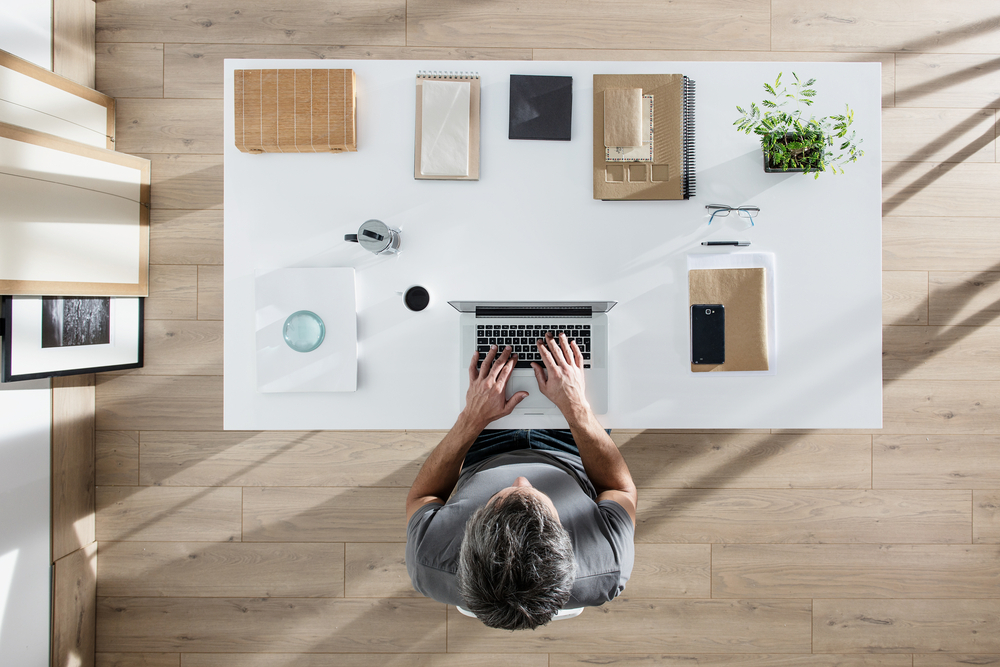
The most basic minimal workspace is a desk with barely anything on it.
Remove anything that is not needed for your current task. If you’re writing, a glass of water and your screen are enough. Everything else gets stuffed in a drawer or off the desk entirely.
This compels your eyes — and your brain — to focus on what’s important.
What you need:
- A clean desk surface
- One monitor or laptop
- One notepad (optional)
- Everything else: hidden away
A lot of people resist this because they believe stuff is going to be “needed” close by. The reality, however, is that most of the things on people’s desks sit there gathering dust and adding unnecessary mental noise.
Try it for one day. You’ll feel the difference within an hour.
2. The Single-Monitor Corner Setup
Though two screens may seem like peak productivity, for most people they dilute attention rather than expand it.
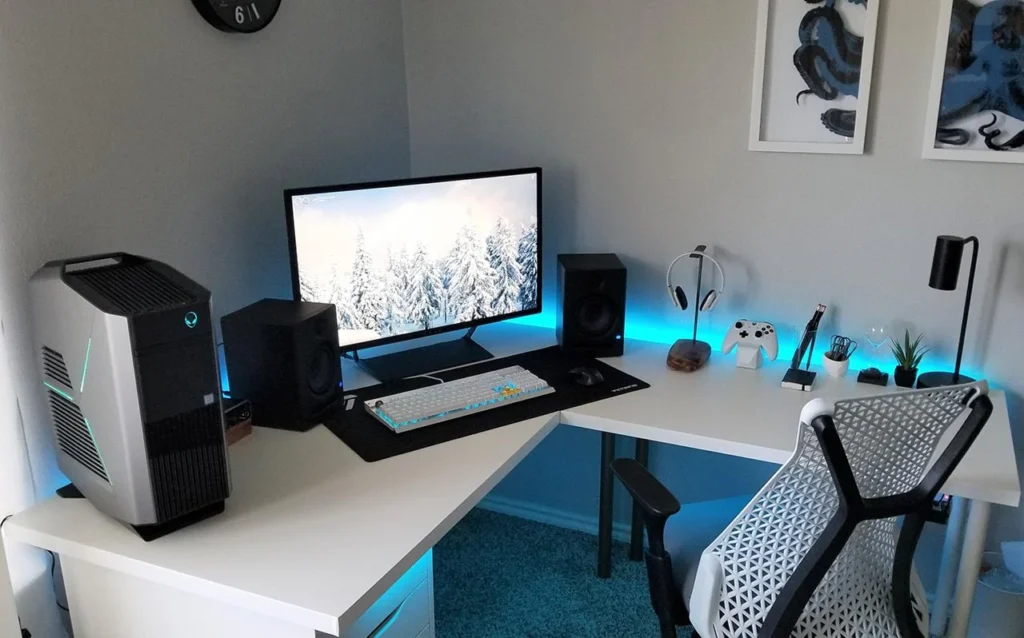
A single monitor parked at the corner of a room — or turned toward a featureless wall — inherently restricts your view. Your visual field stays narrow. Your focus follows.
That arrangement is particularly good for writers, coders, and students who need to stay put in one task for an extended period of time.
Pro tip: Position the monitor toward a blank wall, not a window or entrance. Movement outside your field of view is among the fastest focus-killers.
3. The Standing Desk With Nothing Extra
Standing desks are in vogue, but the vast majority of users pile them high with the same clutter as a regular desk.
The secret is to use a standing desk minimally. No monitor arm loaded with accessories, sticky notes all over the place, or cable mess.
Leave your surface as clear as it can be for what you are working on.
Standing also promotes blood circulation, which in turn aids mental alertness. Combine that with a clean surface and you now have a workspace that keeps both your body and brain active.
4. The Empty Wall + Natural Light Setup
Lighting is more important than most people understand.

Natural light wakes you up, helps regulate your sleep cycle, and boosts mood — all of which directly influence how well you concentrate. Add a window on one side and a totally blank wall in front of you, and you have one of the most focus-friendly minimal workspaces possible.
No art. No shelves. No distractions in your sightline.
Only light and a wide-open view in front.
If no natural light is available, a quality daylight bulb (5000K color temperature) does the trick as well. Place it above or slightly in front of your workspace, not behind your screen.
5. The Analog-Only Desk
This is bold, but it works.
Go fully analog for focused work sessions. A notebook, a pen, and nothing with a screen.
It’s great for brainstorming, planning, journaling, or working through a difficult problem. Screens come with notifications, tabs, and temptation. Paper doesn’t.
Many productive thinkers in every field — from CEOs to novelists — keep physical notebooks as part of their daily flow. In the most literal sense, it’s a minimal workspace.
When to use it: Morning planning sessions, creative thinking blocks, or whenever your screen is slowing you down.
6. The Dark Mode + One Tab Rule
Your digital space is part of your workplace as well.
Having 30 open tabs in a browser is just as distracting as a messy desk. The “dark mode + one tab” setup treats your screen like a minimal workspace.
Use dark mode for all apps. Only keep a single browser tab open at once. Close everything that isn’t related to your current task.
This minimizes visual stimulation, fostering a sense of calm even in your digital space. Paired with a clean physical desk, they form one of the most potent minimal workspaces for achieving deep work.
Tools that help:
- One Tab (browser extension)
- Focus mode in your OS
- Full-screen app windows
7. The Notebook Station
The smallest workspace is sometimes the most effective.
A notebook station is simply a small, dedicated space — even a corner of your kitchen table — set up with just a notebook, one pen, and maybe a lamp.
No tech. No extra items.
This works beautifully when you want to think clearly without any digital help. It’s also simple to set up and put away quickly, making it a great option for those without a dedicated home office.
8. The Morning Reset Workspace
The most important minimal workspace habit has nothing to do with what you have on your desk — it centers around when you reset it.
Use two to three minutes in the morning to clear your workspace before starting the day. Put away what you used yesterday. Wipe the desk surface. Put your tools right where they need to be.
This daily ritual accomplishes two things. For one, it clears away the debris from last night. Second — and more importantly — it signals to your brain that work is starting. It serves as a focus trigger.
Eventually, the process of arranging your workspace becomes the routine that signals to your brain that it’s time to get to work.
9. The Single Lamp, Dark Room Setup
Some people concentrate better in a slightly darker, quieter space.
If that sounds like you, experiment with a single lamp aimed at your work surface while the room’s main lights are turned off. This limits your visual attention to the illuminated area in front of you — as if you were standing in a spotlight on a stage.
Everything beyond that cone of light fades away. Your brain will naturally gravitate toward whatever is lit up.
This is particularly nice at night or in rooms with ample natural light that you can’t completely eliminate during the day.
10. The Two-Item Rule Desk
This is a strict but highly effective approach.
Only two objects are permitted on your desk at a time. That’s it. Everything else must be somewhere else — in a drawer, on a shelf, or in another room altogether.
The rule sounds extreme. But it takes away the hardest part of maintaining a minimal workspace: deciding what stays and what goes. The decision is already made with a limit of two items.
Most people choose a laptop and a drink. Some take a notebook and pen. Whatever you choose, your two items need to directly link back to the work that is right in front of you.
Anything else? It doesn’t belong on the desk.
11. The Mobile Focus Kit
For those who work from multiple places — cafes, libraries, shared offices — the challenge is designing a minimal workspace that travels with you wherever you go.
The mobile focus kit solves this.
Fill a small pouch or bag with just the essentials: your laptop, a single pair of noise-canceling earbuds, a portable charger, and one physical notebook. Only set up those things when you arrive somewhere. Nothing extra.
The consistency of your kit becomes the cue for focus. So no matter where you are, when you unpack those particular items in that particular way, your brain learns what to expect next.
It’s a lightweight workspace that goes wherever you go.
The Psychology Behind Minimal Workspaces
It’s worth stopping here to consider what makes these setups work so well.
Researchers at Princeton University found that visual clutter competes for attention. When your environment is saturated with unrelated objects, your brain has to process them all — including the ones you’re not even paying attention to. That depletes the mental energy you could be spending on your work.
Minimal workspaces address this by limiting what your brain has to process.
There is something else known as environmental cues. Your brain associates certain environments with certain behaviors. If you always work in a clean, specific setup, your brain starts to associate that setup with focused work. Gradually, just sitting down in that space activates your focus response automatically.
That’s the deeper power of a minimal workspace. It’s not only about clearing clutter — it’s about retraining your brain. If you want to explore more ideas and inspiration, Minimal Workspaces is a great resource dedicated entirely to this way of working.
How to Create Your Own Minimal Workspace Now
You won’t have to purchase anything new or remodel your room.
Here’s a straightforward, step-by-step approach you can take right away:
Step 1 — Remove everything from your desk. Put it all on the floor or in a box. Every single item.
Step 2 — Only put back what you actively use every single day. Generally, this is your computer and a couple of small items.
Step 3 — Find a designated home for everything else. Drawers, shelves, or another room. Out of sight, out of mind.
Step 4 — Deal with cables. Messy cables are one of the biggest visual distractors. Hide them with cable ties or a simple cable box.
Step 5 — Set a reset rule. Determine when you want to reset your workspace each day — morning, evening, or both. Stick to it.
That’s it. A bare-bones workspace you can set up in less than 30 minutes, using things you already have.
Pitfalls That Destroy Your Minimal Workspace
Many people who love the idea of a minimal workspace still sabotage themselves. These are the most common mistakes to avoid.
Keeping “just in case” items on your desk. If you haven’t used it in three days, it doesn’t belong on your work surface. Remove it.
Ignoring digital clutter. A clean desk next to a screen crammed with open apps and browser tabs is only half the answer. Minimize both.
Buying more stuff to organize your stuff. Desk organizers, pen holders, and storage solutions often add visual noise rather than reduce it. The aim is fewer things, not better-organized piles.
Not being consistent. A minimal workspace only works as a habit. A weekly reset won’t train your brain the way a daily one will.
Making it too perfect. Perfectionism can prolong the entire process. Your minimal workspace doesn’t have to look like it belongs in a magazine. It just needs to be clear enough for your brain to settle.
Small Tweaks That Enhance Your Minimal Workspace Without Adding Clutter
Minimal doesn’t mean cold or uncomfortable. There are a few minor additions that help narrow focus without creating clutter.
A small plant. Studies indicate that the presence of even one living plant in your workspace can ease stress and improve air quality. Just one small plant — not a collection of pots.
A single scent. A candle or small diffuser with a consistent scent can actually help with focus. Over time, your brain begins to link that scent with work — just as a room setup becomes a cue. According to research published in the journal Chemical Senses, scent is one of the most powerful environmental triggers for cognitive state.
Comfortable chair height. Physical discomfort is a hidden focus-killer. Ensure that your chair, desk, and screen height are all adjusted correctly. A sore shoulder or a stiff neck will pull you out of focus faster than any messy desk.
Noise-canceling headphones. Not music necessarily — sometimes silence. The headphones send a signal to your brain (and the people around you) that it’s work time.
FAQs About Minimal Workspaces
Q: Is a minimal workspace expensive to create?
No. Most setups on this list are completely free. You already have everything you need. The main change is not acquiring new things, but eliminating them. The most you might spend is on a lamp or a pair of earbuds — both of which are optional.
Q: Does a minimal workspace work when I’m in a shared space?
Yes. You don’t have to be in a private room. The notebook station, the mobile focus kit, and the two-item rule all work at kitchen tables, shared desks, and co-working spaces. The trick is designating a small, consistent patch — even just a corner of a table — as your focused work zone.
Q: How long does it take for a minimal workspace to help me concentrate?
For many people, there is a difference the same day. Deeper benefits, such as the automatic focus trigger from your environment, typically emerge over one to three weeks of consistent use. The morning reset habit is the quickest way to accelerate that process.
Q: What if I need several items for my job?
That’s fine. The aim is not to reduce your toolkit — it’s to keep only active tools visible. If you need three monitors to do design work, use three monitors. Just don’t stack notebooks, chargers, mugs, sticky notes, and miscellaneous items around them. Whatever is on the desk should match what you are doing right now.
Q: Does music or background noise help in a minimal workspace?
It varies depending on the person and the task. Instrumental music or ambient sound (such as rain or brown noise) works best for repetitive tasks. For harder writing or problem-solving, silence is often more effective. Try both and stick to whatever your brain responds to.
Q: Is a minimal workspace the same thing as minimalism?
Not exactly. Minimalism is a lifestyle philosophy that advocates for owning less overall. A minimal workspace is only about your work area. You can live in a warm, full home and still maintain a clean, distraction-free desk. The workspace concept stands alone — you don’t have to embrace an entire lifestyle to benefit from it.
Wrapping It Up
Your workspace is more than just a place where you work. It’s a tool that determines how productively you work.
Minimal workspaces eliminate the friction between you and your best thinking. They reduce the mental overhead, cut out distractions, and — over time — condition your brain to shift into focus mode more quickly and consistently.
You don’t need an optimal setup. You don’t need fancy furniture or a dedicated home office. You only need to take away the things that don’t belong and keep the ones that do.
Choose one setup from this list that reflects your situation. Try it today. Even a 15-minute desk clear can transform the quality of your next work session.
Start small. Stay consistent. Let the space do the work.